Perri.Sync
A shared household app for expenses, calendar, habits, and chores, with a WebGL game layer and a .NET API behind it.
- Outcome
- One household product for expenses, calendar, habits, and chores, with a .NET API and Auth0 multi-tenant households.
- Problem
- Couples run a house across spreadsheets and chats until something falls through the cracks.
- Decision
- Four repos (dashboard, landing, API, WebGL game) with JWT plus household scoping, instead of a monolith or a shared-password mess.
- Result
- Shared house ops live in one product surface, including a game layer so chores get opened on purpose.
Metrics
Tenant blast radius
1 household
Auth gate
JWT + membership
- Stack
- .NET 10
- Next.js
- React
- TypeScript
- Auth0
- WebGL
- Tailwind CSS
- Started
Context
Shared expenses in one spreadsheet. Chores in another chat. The calendar somewhere else. That split is how most couples run a house until something falls through the cracks.
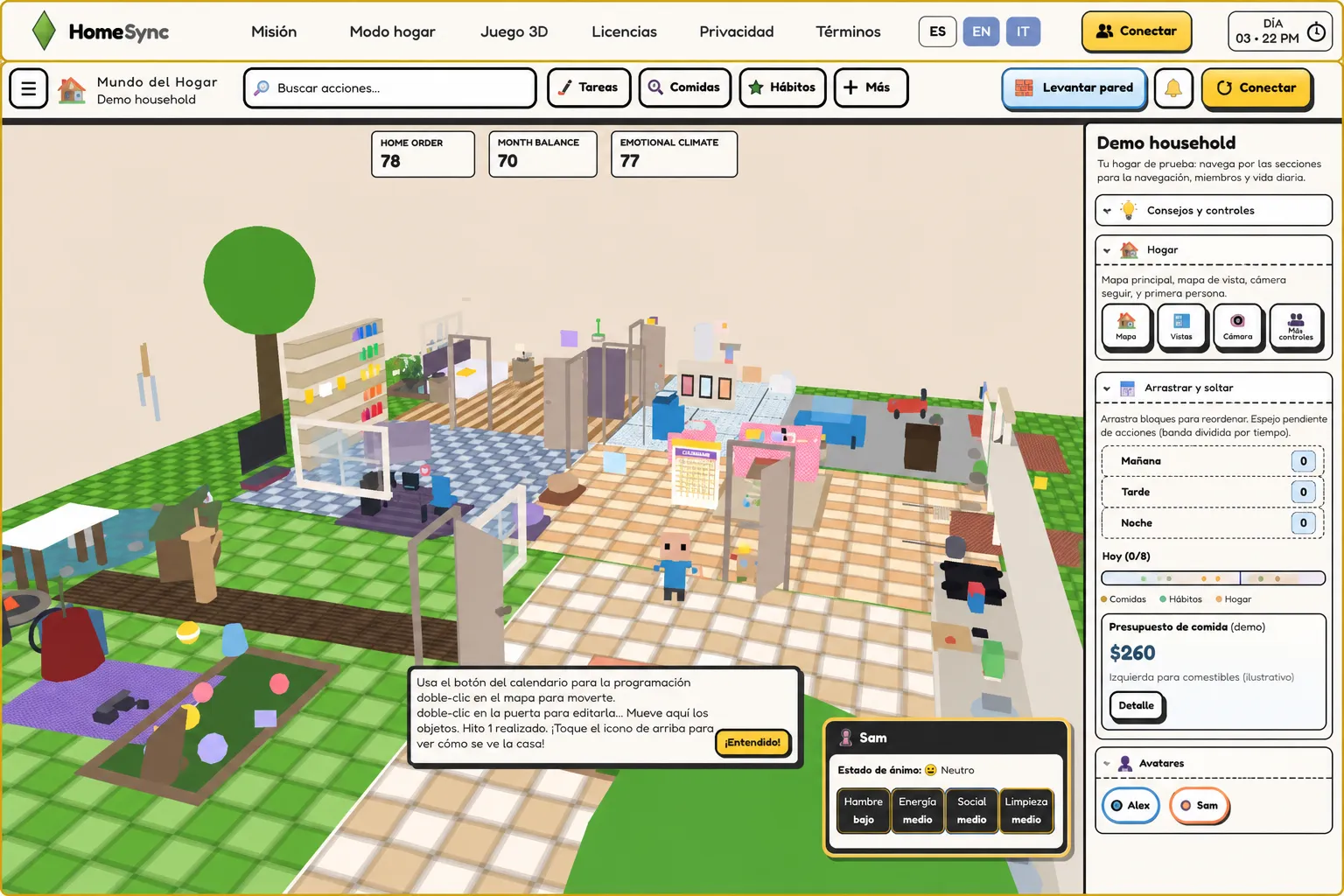
I built Perri.Sync so that stuff lives in one place: expenses, calendar, habits, chores, meals, a small chat, and pet care. The game layer turns “who does the dishes?” into something you open because you want to, not only because you should.
Constraints
- Repos stay private. This page has to show the product without the source tree.
- One person can belong to more than one household without mixing data.
- Free vs premium has to be enforceable on the API, not only on a pricing page.
- The WebGL layer must use the same assignments as the checklist UI. Two skins, one model.
Architecture decision
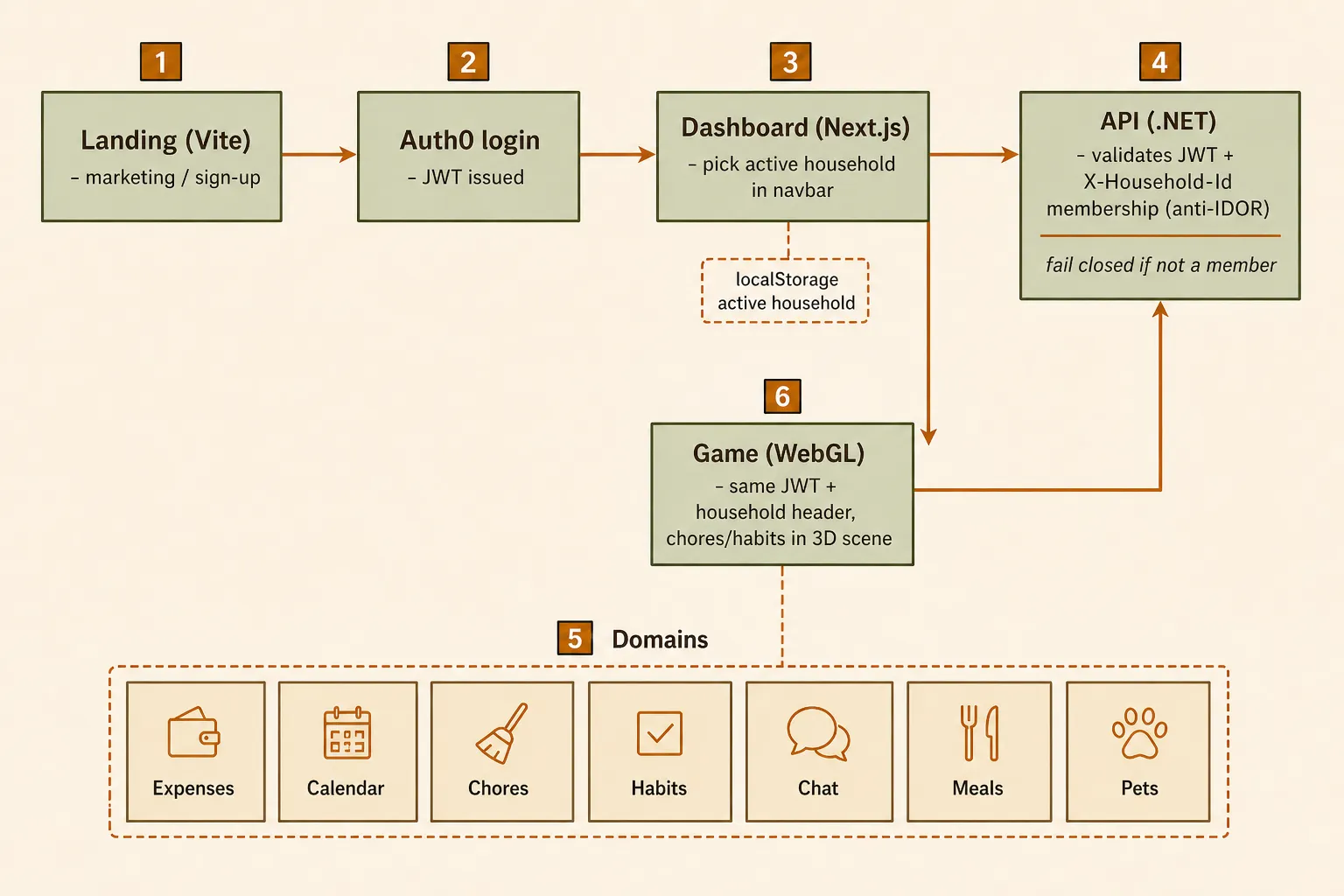
Four repos, one product. The diagram above is the path a user takes: landing → Auth0 →
dashboard (pick household) → API, with the WebGL game reusing the same JWT and
X-Household-Id. Why not a monolith? The game build, the marketing site, and the
API release on different clocks. Why not a shared password for the house? Auth0 per user
plus household membership is the trust model.
| Piece | Repo | Role |
|---|---|---|
| Dashboard | Perri.Sync.Dashboard.New | Main app, all household features |
| Landing | Perri.Sync.Landingpage | Marketing and sign-up |
| API | Perri.Sync.Api | REST backend (Auth0 JWT, EF Core) |
| Game | Perri.Sync.Game.WebGL | Interactive chore layer |
Landing is the public face: what it does, pricing tiers, how you get in.
Dashboard is Next.js 15, React 18, TypeScript, Tailwind, Auth0, TanStack Query,
Recharts. Three themes through next-themes: Light, Dark, and Game (Sims-inspired UI that
matches the WebGL layer). Same data model, same API calls, different skin.
Game syncs assignments from the API. You finish tasks inside a WebGL life-sim scene or fall back to the checklist. Same household, two ways in.
API is .NET 10, layered controllers → services → repositories → models, with FluentValidation on request DTOs. A sample of the surface (there are more domains: calendar, habits, chat, meals, pets):
| Domain | Endpoints | Feature |
|---|---|---|
| Expenses | GET /expenses/monthly, GET /expenses/summary |
Shared spending grid |
| Chores | GET /chores/assignments, PUT /chores/assignments |
Daily tasks → game |
| Settings | GET /settings, POST /settings/members |
Multi-member households |
| Avatar | GET/PUT /avatar |
Profile / game character |
GET /api/v1/expenses/monthly?year=2026
Authorization: Bearer {jwt}
X-Household-Id: {household-guid}
Security / blast radius
Auth0 JWT on every route. X-Household-Id scopes the request. Membership is checked server
side so one household cannot read another by swapping the header (classic IDOR if you skip
that check). The workflow diagram above is the product path. The dashboard keeps the active
household in localStorage and sends it on every call; switching homes changes the header,
not the JWT claims. Tenant IDs stay out of the token on purpose: membership is a DB join on
Auth0 sub + household id. Fail closed in the service layer:
Member? member = await _householdContextResolver.ResolveMemberAsync(
    auth0Id,
    householdId,
    includeHousehold: false,
    includeNotificationPrefs: false);

if (member == null)
    return Array.Empty<ChoreDto>(); // fail closed

return await _choreRepo.GetByHouseholdIdAsync(member.HouseholdId, cancellationToken);
Free households get chat and expenses. Premium unlocks chores and higher member limits.
That gate lives on the API. Swagger stays available in development at /swagger only.
Blast radius of a leaked JWT is one user across the households they belong to, not the whole product, as long as household authorization stays honest.
Ops
Collaborators open the private repo links; this page shows the product walkthroughs above. Swagger for local API work. Themes and Auth0 config are part of the app deploy, not a separate console product.